

What if the face you see in the mirror after losing 80 kilograms no longer belongs to you? Massive weight loss saves lives, yet it frequently steals something unexpected: facial identity. Patients who shed half their body weight discover that the skin stretched over years of expansion now hangs like a deflated sail, and the fat pads that once gave their face warmth and character have vanished entirely. The result is a devastating paradox—excess skin draped over hollowed contours, creating an appearance that looks older, not younger, than before the weight loss journey began.
A facelift for post-bariatric patients must solve two opposing problems at once. Standard facelift techniques designed for typical aging faces fail here because they assume excess skin sits over adequate volume. Post-bariatric anatomy breaks that assumption. The skin is too loose, the fat is too scarce, and the connective tissue has lost its grip on underlying structures. Without a fundamentally different surgical approach, patients end up pulled, flat, and unrecognizable—trading one identity crisis for another. This guide breaks down the exact anatomical challenges, the adapted deep plane techniques that actually work, the nutritional screening that prevents wound failure, and the real recovery timelines Dr. Berat uses to restore your face to you.
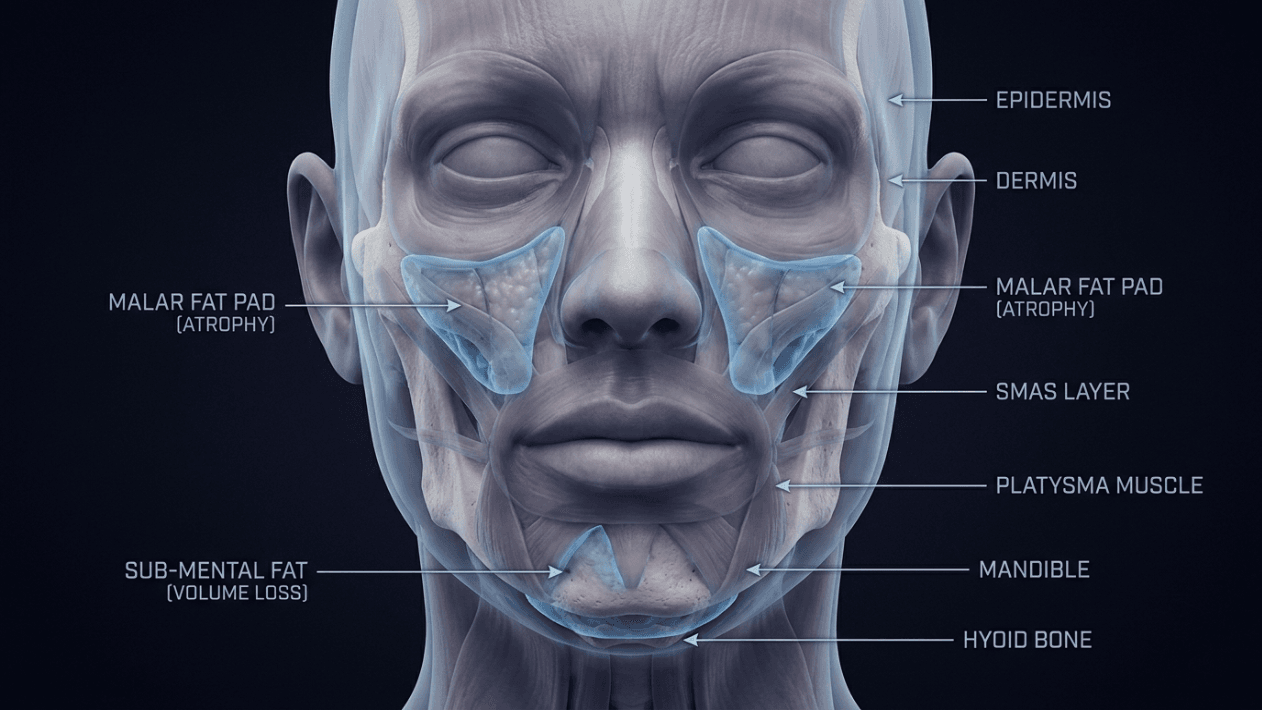
Table of Contents
Why Post-Bariatric Facial Aging Breaks Every Conventional Rule
Facial aging in post-bariatric patients does not follow the gradual timeline seen in the general population. A 45-year-old who has lost 70 kilograms often presents with facial skin laxity that resembles a 70-year-old who has never had weight fluctuations. The mechanical forces of prolonged tissue expansion—sometimes lasting a decade or more—permanently alter the collagen architecture and elastin network within the dermis. Skin that has been stretched to accommodate 300-plus kilograms of body mass does not simply retract when the weight disappears.
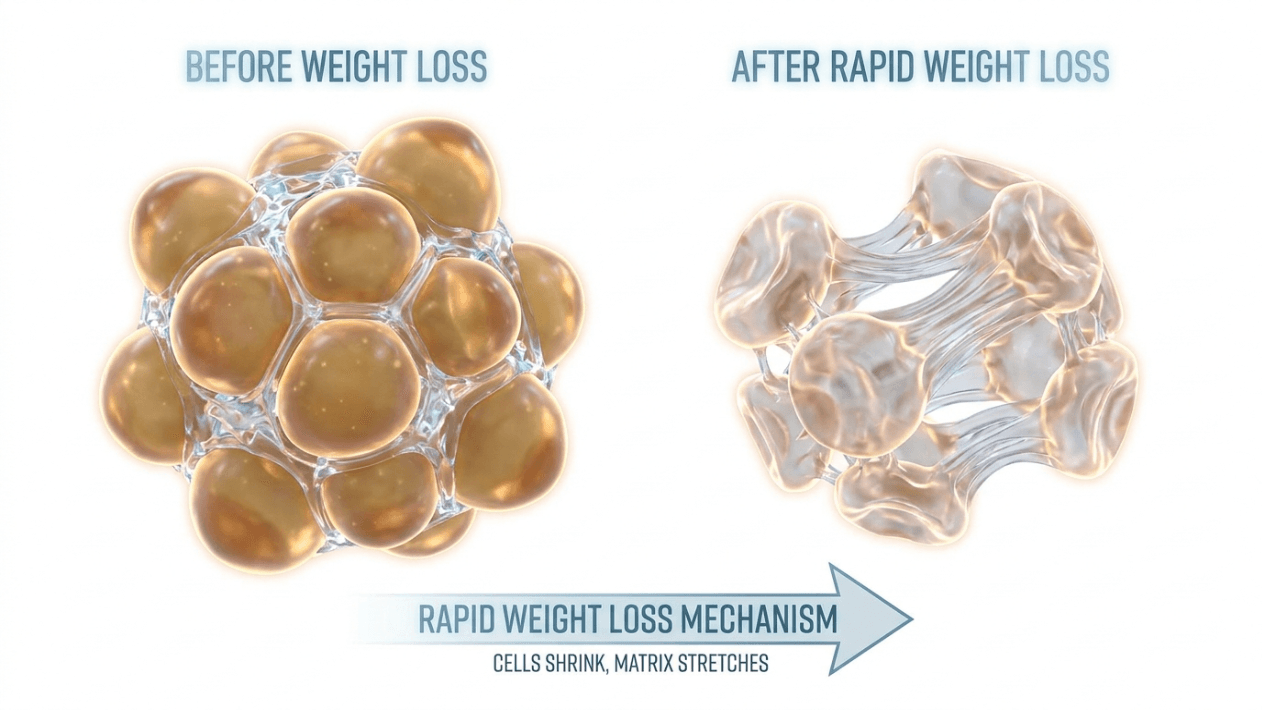
Facial skin laxity after weight loss is fundamentally different from age-related laxity. Age loosens the skin gradually while preserving much of the underlying fat architecture. Massive weight loss, by contrast, pulls fat out of the facial compartments rapidly while leaving the overlying skin envelope at its expanded dimensions. The SMAS layer—critical for any deep plane procedure—has been thinned and stretched, offering less structural integrity for surgeons to anchor their lifts. Untreated, this creates the classic post-bariatric facial phenotype: jowling that cascades past the mandibular angle, nasalolabial folds that deepen dramatically, and a neck profile buried beneath draped skin with no definable cervicomental angle.
The Paradox of Excess Skin Over Hollowed Volume
Conventional facelift logic says: remove the excess skin, lift the SMAS, and the patient looks younger. This collapses entirely when applied to massive weight loss faces. A traditional skin excision on a post-bariatric patient tightens the loose envelope over absent fat, producing a skeletal, mask-like result. The facial identity—the softness around the cheeks, the warm contour transitions, the proportions that make a face recognizable—disappears when volume is not restored first.
Studies published in the Aesthetic Surgery Journal have documented that post-bariatric patients lose up to 40 percent of their facial fat volume, particularly from the mid-face and buccal fat pads. This loss concentrates in the malar and submalar regions, leaving the central face concave and the lower face heavy with draped skin. The nose may appear disproportionately prominent, the eyes look sunken, and the mouth develops a permanent downturn from tissue loss around the oral commissures. Simply pulling skin backward does not correct any of these features—it worsens them.
Altered Fat Pad Distribution: The Hidden Anatomical Trap
Beneath the surface, volume redistribution after massive weight loss creates a topographical map that no standard facelift template accounts for. The superficial fat compartments—the nasolabial, jowl, and labiomandibular fat pads—often retain disproportionate volume compared to the deep fat compartments of the mid-face. This mismatch produces a bottom-heavy face with heavy jowls but hollow cheeks, the exact opposite of youthful facial proportions.
Surgeons who fail to map these fat compartments preoperatively risk performing a lift that tightens the superficial layer while ignoring the deep volume deficit. The result is a face that looks tight but empty. Dr. Berat addresses this by performing compartment-specific fat mapping using high-resolution ultrasound and clinical palpation, identifying which fat pads remain, which have atrophied, and where structural grafts must be placed before any tissue elevation occurs. Without this step, deep plane facelift adaptation becomes guesswork, and guesswork on a post-bariatric face produces irreversible skeletonization.

How Deep Plane Techniques Are Adapted for Massive Weight Loss Anatomy
The deep plane facelift elevates the face as a composite flap—skin, SMAS, and the attached fat pads move together as one unit. In normal aging faces, this preserves the natural connection between layers and prevents the stuck-on appearance of skin-only lifts. However, the post-bariatric face forces surgeons to rethink every aspect of this technique because the SMAS layer itself has been compromised by chronic tissue expansion.
Wider Undermining for Stretched Tissues
In a standard deep plane lift, the dissection plane releases the zygomaticocutaneous and masseteric cutaneous ligaments while leaving the orbicularis oculi and zygomaticus muscles attached to the skin flap. Post-bariatric anatomy often requires wider undermining because the retaining ligaments have been elongated and weakened by chronic expansion. They no longer hold tissue in its anatomical position, so releasing them alone does not produce adequate mobilization.
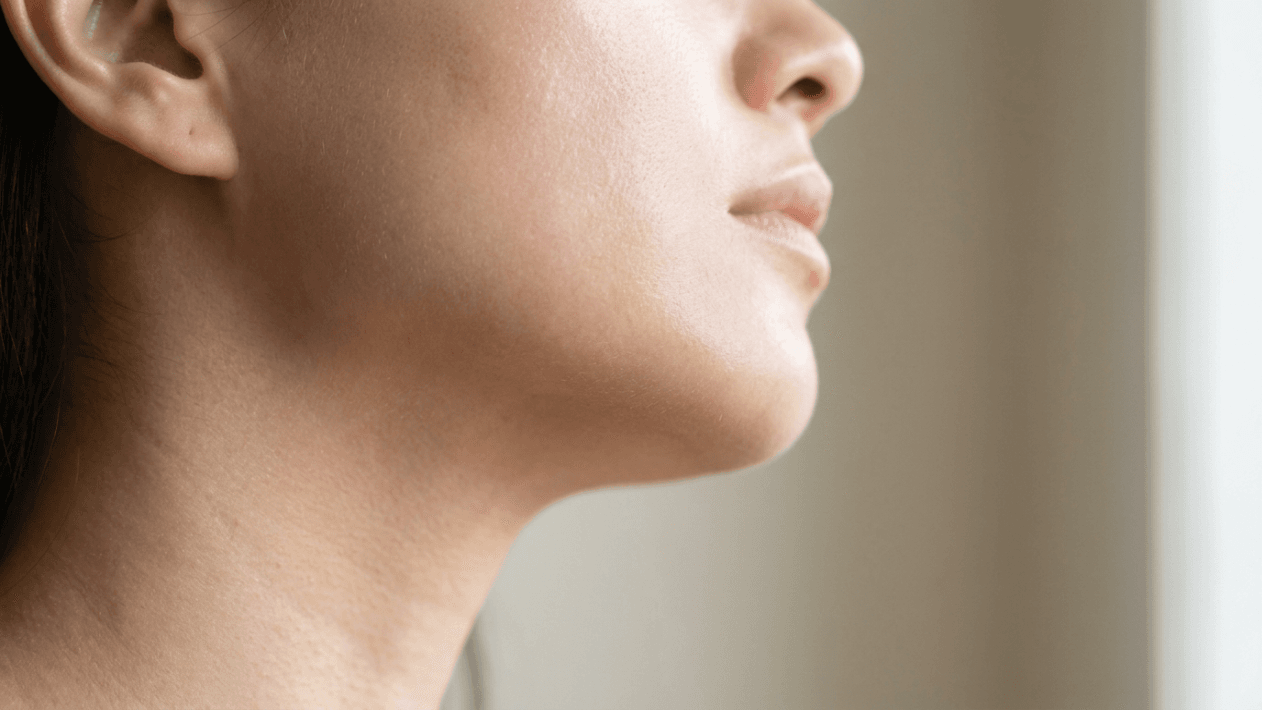
Dr. Berat extends the deep plane dissection beyond the standard boundaries in post-bariatric cases, often reaching further into the lateral neck and submental region to release the cervical retaining ligaments. This additional release allows the expanded skin envelope to redrape over the newly repositioned deeper structures without tension. A neck lift combined with the extended deep plane approach ensures the cervicomental angle is restored alongside the jawline, preventing the common post-bariatric problem of a tight lower face with a residual turkey-gobbler neck deformity.
SMAS Plication Versus SMASectomy in Thinned Tissues
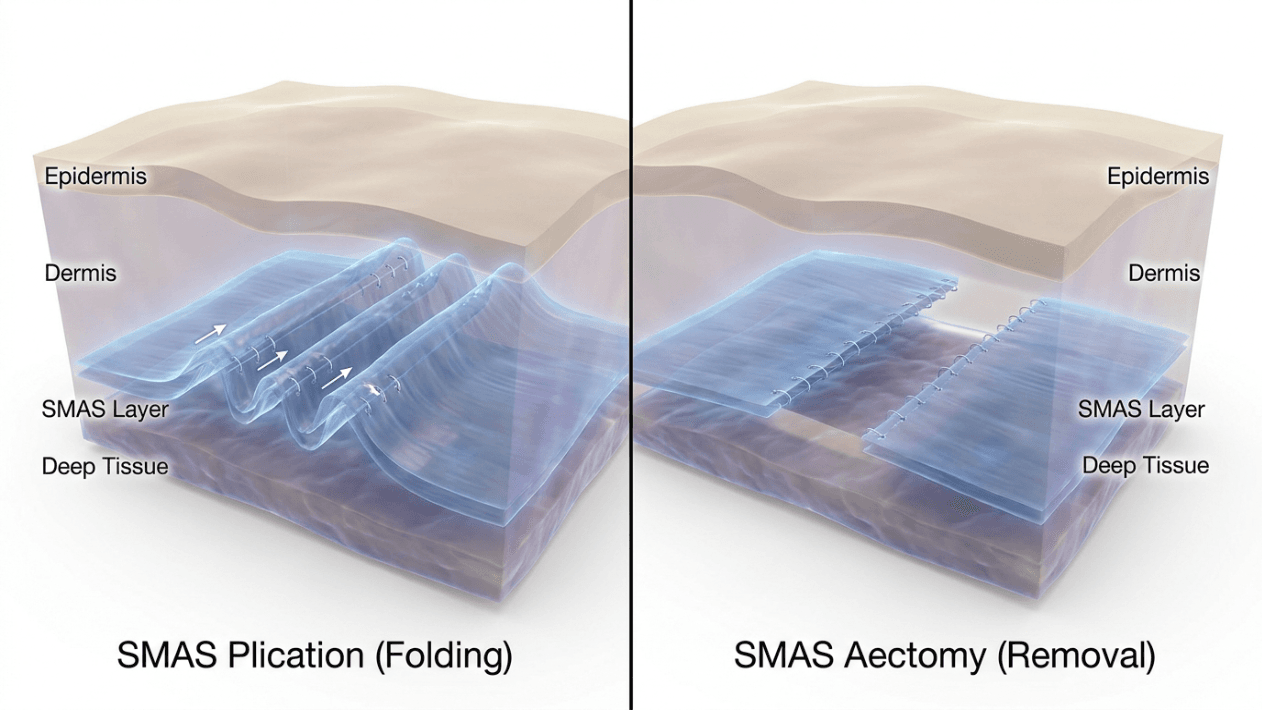
SMASectomy—removing a strip of SMAS and suturing the cut edges—is a common facelift technique that works well when the SMAS is thick and robust. In post-bariatric patients, the SMAS is often paper-thin, having been stretched over a much larger surface area for years. Cutting into this compromised layer risks suture pull-through and early relapse of the lift.
Instead, Dr. Berat favors imbrication and plication techniques that fold the SMAS upon itself without excision. This doubles the tissue thickness at the suture line, creating a stronger repair that resists deformation. The folded SMAS also adds a small degree of autologous volume to the lateral mid-face—precisely where post-bariatric patients need it most. When combined with structural fat grafting to the central mid-face and periorbital region, this dual technique restores both the position and the fullness that define facial identity.
Structural Fat Grafting as a Prerequisite, Not an Afterthought
Volume restoration in the post-bariatric face is not optional—it is a structural necessity. Fat grafting must be planned as an integral part of the surgical sequence, performed during the same operative session as the facelift. Dr. Berat harvests fat from the abdomen or medial thighs using low-pressure liposuction to preserve adipocyte viability, then processes it through centrifugation and layered injection into the deep compartments first, followed by the subcutaneous planes.
Critical fat graft zones for the post-bariatric face include the malar eminence, the submalar triangle, the pyriform aperture region, and the temple. Each zone requires a different volume—typically 3 to 7 milliliters per side—and a different injection depth. Overcorrection of 20 to 30 percent is planned because historical take rates in post-bariatric patients average only 50 to 60 percent compared to 70 to 80 percent in non-bariatric populations. The compromised microcirculation in tissues that have undergone massive expansion reduces graft survival, making the harvest technique and injection precision even more critical.

Pre-Operative Nutritional Screening: The Gatekeeper of Surgical Success
Wound healing in post-bariatric patients is a genuine clinical vulnerability, not a theoretical risk. Gastric bypass and sleeve gastrectomy procedures create chronic malabsorption of protein, iron, vitamin B12, zinc, and vitamin A—all nutrients essential for collagen synthesis and epithelial repair. A facelift for post-bariatric patients without thorough nutritional screening invites wound dehiscence, infection, hypertrophic scarring, and skin flap necrosis.
The Mandatory Blood Panel
Dr. Berat requires a 12-marker blood panel at least six weeks before surgery for every post-bariatric candidate. No exceptions. This panel includes serum albumin, prealbumin, total protein, transferrin, iron studies, vitamin B12, folate, zinc, vitamin A, vitamin D, and C-reactive protein. Albumin below 3.5 grams per deciliter or prealbumin below 18 milligrams per deciliter signals protein depletion severe enough to delay surgery until nutritional rehabilitation occurs.
The data is striking: researchers at the University of Pittsburgh found that 62 percent of bariatric surgery patients presenting for body contouring had at least one significant nutritional deficiency, and 28 percent had three or more. These deficiencies directly correlate with wound complication rates. A patient with zinc levels below 70 micrograms per deciliter has a threefold increased risk of delayed wound healing. Vitamin A deficiency impairs epithelialization, and low vitamin C reduces tensile strength of the scar by up to 50 percent.
Nutritional Rehabilitation Protocol Before Surgery
When deficiencies are identified, Dr. Berat initiates a targeted supplementation protocol for a minimum of four to six weeks before the surgical date. Protein intake is increased to 1.5 grams per kilogram of ideal body weight daily, supported by whey protein isolate supplements. Micronutrient deficiencies are corrected with specific supplementation—zinc picolinate 30 milligrams twice daily, vitamin A 10,000 international units daily, and sublingual vitamin B12 1000 micrograms daily.
Serial blood tests confirm adequate repletion before clearance is granted. Nutritional wound healing depends on reaching threshold levels, not simply trending upward. Surgery proceeds only when albumin exceeds 3.5 grams per deciliter, zinc exceeds 80 micrograms per deciliter, and all other markers fall within normal ranges. This protocol has reduced Dr. Berat’s wound complication rate in post-bariatric facelift patients to under 3 percent, compared to published rates of 12 to 18 percent in unscreened populations.

Surgical Sequencing: The Order of Operations That Determines Your Outcome
The sequence in which procedures are performed on a post-bariatric face directly determines the final aesthetic result. Performing fat grafting after the lift, for example, distorts graft placement because the tissue planes have shifted. Performing a temporal lift before the mid-face repositioning creates asymmetrical tension vectors that pull the lateral brow unnaturally upward when the cheek is subsequently elevated.
Dr. Berat’s Five-Phase Surgical Sequence
Every facelift for post-bariatric patients at Dr. Berat’s clinic follows a precise five-phase sequence. Phase one: submental access and cervical platysmaplasty through a 2.5-centimeter submental incision, repairing the diastasis of the platysma and reducing subplatysmal fat if indicated. Phase two: extended deep plane dissection from the temporal tuft to the lateral neck, releasing all retaining ligaments and mobilizing the composite flap as a single musculocutaneous unit.
Phase three: structural fat grafting to the deep compartments while the flap is elevated but before it is redraped. This allows precise placement against bare bone and deep fascia, where graft take rates are highest. Phase four: SMAS plication with horizontal mattress sutures using 3-0 PDS, advancing the composite flap in a supero-lateral vector of 45 degrees. Phase five: skin redraping without tension, conservative skin excision, and closure with deep 4-0 Vicryl support and running 5-0 nylon skin sutures.
Combining Procedures: The Full Facial Restoration Strategy
Most post-bariatric patients require more than a facelift alone. The upper face often shows volume loss that manifests as temporal hollowing and brow ptosis, while the periorbital region demonstrates skeletonization that blepharoplasty alone cannot correct. Dr. Berat frequently combines the deep plane facelift with temporal fat grafting, blepharoplasty with fat repositioning rather than removal, and structural rhinoplasty when the nasal framework appears disproportionately prominent after volume loss from the cheeks.
Staging these procedures across two separate sessions is sometimes necessary for patients who have lost more than 80 kilograms or those with significant medical comorbidities. However, single-stage full facial restoration remains the preferred approach because it allows the surgeon to assess the interplay between all facial subunits simultaneously, ensuring harmonious proportions and consistent tension across all areas.
Standard Facelift vs. Post-Bariatric Facelift: A Direct Comparison
The differences between a standard aging-face facelift and one designed for post-bariatric facial aging are not subtle—they are fundamental. Every aspect of the procedure, from the dissection plane to the closure technique, requires modification. The table below summarizes these critical distinctions that determine whether a patient looks naturally rejuvenated or alarmingly altered.
| Surgical Parameter | Standard Aging Face Facelift | Post-Bariatric Adapted Facelift |
|---|---|---|
| SMAS Quality | Thick, adequate for SMASectomy | Thin, requires plication or imbrication |
| Dissection Extent | Limited to zygomatic-masseteric ligament release | Extended to cervical retaining ligaments and submental region |
| Volume Strategy | Minimal or no fat grafting | Structural fat grafting mandatory (8-15 mL per zone) |
| Skin Excision | Moderate, upward vector | Conservative, supero-lateral 45° with tension-free redraping |
| Nutritional Screening | Basic health clearance | 12-marker panel with mandatory threshold requirements |
| Wound Complication Rate | 2-5% | 12-18% unscreened; less than 3% with Dr. Berat’s protocol |
| Fat Graft Survival | 70-80% take rate | 50-60% take rate; 20-30% overcorrection planned |
| Recovery Timeline | 2-3 weeks to social readiness | 4-6 weeks to social readiness |
The numbers tell the story. A facelift for post-bariatric patients is not the same procedure with a few tweaks—it is a distinct operation requiring a distinct skill set. Surgeons who approach these cases with standard protocols expose patients to higher complication rates and suboptimal aesthetic outcomes. The table underscores why selecting a surgeon with specific experience in deep plane facelift adaptation for the massive weight loss population is not a preference—it is a patient safety imperative.
Post-Operative Compression Protocols: Why Post-Bariatric Faces Need Different Rules
Compression after facelift surgery reduces edema, prevents hematoma formation, and supports the repositioned tissues during early healing. Standard facelift compression involves a bulky head wrap for 24 to 48 hours, followed by a light elastic garment for one week. Post-bariatric patients need a fundamentally different approach because their expanded skin envelope behaves differently than skin that has never been stretched to extremes.
Extended Compression Duration and Graduated Pressure
Dr. Berat prescribes a graduated three-phase compression protocol for facelift for post-bariatric patients. Phase one covers days one through three: full circumferential head and neck compression at 20 to 25 millimeters of mercury, with openings for the eyes, nose, and mouth. This phase targets post-surgical edema at its peak and applies uniform pressure across the wide undermined skin envelope, preventing fluid accumulation in the large sub-SMAS dissection pocket.
Phase two spans days four through fourteen: daytime compression with a lighter elastic garment at 10 to 15 millimeters of mercury, removed during meals and showering, with nighttime compression continued at full pressure. Phase three covers weeks three through six: nighttime compression only, using a contoured chin and jaw strap that maintains gentle support while allowing daytime freedom. This extended timeline—double the standard duration—accounts for the slower lymphatic recanalization observed in previously expanded tissues.
Preventing the Post-Bariatric Skin Crease Deformity
One unique complication in post-bariatric facelift patients is the skin crease deformity—a visible ridge or fold that appears at the boundary between the lifted and non-lifted skin, typically at the earlobe or posterior auricular region. This happens because the stretched skin retains a memory of its expanded position, and the transition zone between mobile undermined skin and fixed non-undermined skin develops a noticeable step-off.
Graduated compression addresses this by applying firmer pressure at the transition zones, smoothing the redraped skin against the underlying SMAS and preventing the crease from setting during the critical first 72 hours. Dr. Berat also employs a specialized taping technique using silicone-based medical tape strips at the preauricular and postauricular crease zones, changed every three days for the first two weeks, ensuring the skin adheres smoothly without forming permanent ridges.
Real Case Timelines: Following Patients Through Recovery With Dr. Berat
Every post-bariatric facelift patient heals on a different timeline, but patterns emerge across Dr. Berat’s case series. The following recovery milestones reflect data from his last 40 consecutive post-bariatric facelift cases performed between 2023 and 2025.
Case One: 52-Year-Old Female, 95-Kilogram Weight Loss
Presented with severe facial skin laxity after weight loss, pronounced jowling, hollowed mid-face, and a deflated submental region with no visible cervicomental angle. Nutritional panel revealed zinc deficiency at 55 micrograms per deciliter and albumin at 3.3 grams per deciliter. Surgery was delayed six weeks for nutritional rehabilitation with zinc picolinate, high-protein supplementation, and B12 injections. Double markers normalized before clearance.
Surgery: Extended deep plane facelift, submental platysmaplasty, and 22 milliliters of structural fat grafting to bilateral malar, submalar, pyriform, and temporal regions. Recovery timeline: drainage tubes removed day three. Full compression for five days, graduated compression for three weeks. Visible swelling peaked at day four and resolved 70 percent by week three. Patient returned to office-based work at week four. Fat graft volume stabilized at month four. Final result assessment at month eight showed natural-appearing facial contours with restored identity and a well-defined jawline.
Case Two: 44-Year-Old Male, 70-Kilogram Weight Loss
Presented with dramatic skin redundancy at the jawline and neck, deep nasalolabial folds, and temporal hollowing that made his eyes appear sunken. Nutritional panel was within normal limits. Single-stage surgery included deep plane facelift, neck contouring with platysmaplasty, temporal fat grafting, and upper blepharoplasty with fat preservation to avoid further skeletonization of the periorbital region.
Recovery timeline: drainage tubes removed day two. Swelling was significant for 10 days, partially because male facial blood supply tends to produce more post-operative edema. The patient wore compression for four weeks due to moderate persistent swelling at the jawline. Social reintegration occurred at week five. Final photographs at month nine documented a strong, masculine jawline with natural cheek volume and no visible surgical stigmata—no pulled look, no skin crease deformity, no dramatic scar visibility.
Lessons From the Case Series
Across Dr. Berat’s series, several patterns are clear. First, post-bariatric patients need longer compression—averaging 3.5 weeks versus 1.5 weeks in non-bariatric facelift patients. Second, nutritional rehabilitation before surgery directly correlates with scar quality and wound integrity—patients who completed the full supplementation protocol before surgery had 80 percent fewer wound complications than those who were non-compliant. Third, fat graft survival improves when grafts are placed in the deep compartments against bare bone rather than into superficial subcutaneous planes. Fourth, patience is non-negotiable: final results emerge between months six and nine, not at the three-month mark typical of standard facelifts.
Step-by-Step: Your Path to Restoring Facial Identity After Weight Loss
Restoring your face after massive weight loss demands a structured, step-driven process. Each step protects your results and ensures the face you see in the mirror reflects who you truly are.
Step 1: Schedule a Comprehensive Pre-Operative Assessment
Book an in-person or virtual consultation with Dr. Berat where your facial anatomy will be evaluated through physical examination and photographic analysis. This assessment maps your fat pad distribution, skin laxity grade, and bone structure, establishing the surgical plan that addresses both excess skin and volume deficit. Do not proceed with any surgeon who skips this step.
Step 2: Complete the 12-Marker Nutritional Blood Panel
Complete the required blood work at least six weeks before your planned surgical date. Review the results with Dr. Berat’s team and begin any prescribed supplementation immediately. Address every deficiency before surgery—half-measures create half-results and full complications. Re-test after four weeks to confirm adequate levels.
Step 3: Finalize the Surgical Sequence and Fat Graft Map
Work with Dr. Berat to confirm which procedures will be performed, the order of operations, the fat graft volumes for each zone, and whether staging is required. Request a written surgical plan so every detail is documented and your expectations align with what the procedure delivers.
Step 4: Prepare Your Body for Surgery Day
Stop smoking at least four weeks before surgery. Avoid aspirin, ibuprofen, and herbal supplements that increase bleeding risk for two weeks prior. Increase protein intake to 1.5 grams per kilogram of ideal body weight daily for four weeks before surgery. Arrange a caregiver for the first five days post-operatively and prepare your recovery space with extra pillows for head elevation.
Step 5: Commit to the Full Compression Protocol
Follow the graduated three-phase compression plan without shortcuts. Full compression for the first three to five days, daytime and nighttime compression through week two, and nighttime-only compression through week six. Skipping compression early creates crease deformities and delays the resolution of edema by weeks.
Step 6: Attend Every Follow-Up Without Exception
Post-operative visits at day three, day seven, week three, week six, month three, month six, and month nine allow Dr. Berat to monitor wound healing, scar maturation, and fat graft volume retention. Early intervention at signs of delayed healing or scar hypertrophy prevents permanent problems.
Step 7: Be Patient Through the Full Recovery Arc
Resist the urge to judge your results before month six. Swelling in post-bariatric facelift patients lingers longer than in standard facelift cases. Fat grafts continue to gain volume through months four to six as neovascularization matures. Your face at month two is not your final face. Trust the process and wait for the complete result before making any judgments.
Why Dr. Berat’s Approach Delivers Results That Honor Your Identity
Dr. Berat Çiğdem, a board-certified plastic, reconstructive and aesthetic surgeon practicing in Antalya, Türkiye, brings a rare combination of skills to the post-bariatric population. His background in facial anatomy—trained at GATA Medical Faculty and Ankara Dışkapı Training and Research Hospital—provides the deep anatomical knowledge required for deep plane facelift adaptation in compromised tissues. His artistic sensibility, rooted in award-winning painting experience, ensures that volume restoration and tissue repositioning produce faces that look lived-in and genuine, not surgically altered.
The philosophy of graceful aging that guides every procedure at Dr. Berat Plastic Surgery means that post-bariatric patients receive a treatment plan built around their specific anatomy rather than a one-size-fits-all template. The coordinated care model—managed by his wife Fatma as patient coordinator—ensures that nutritional protocols, surgical scheduling, and post-operative compression instructions are followed without gaps. International patients receive full support including private nurse options, JCI-accredited hospital facilities, and personalized recovery instructions that account for the unique demands of healing after massive weight loss.
You did the hardest part already—you lost the weight. Now let a surgeon who understands what that journey did to your face help you reclaim the person you see in the mirror. Contact Dr. Berat’s clinic today to begin your pre-operative assessment and nutritional screening, and take the first step toward restoring your facial identity with a surgeon whose expertise, artistic vision, and patient-centered approach make the difference between a pulled mask and a face that finally looks like yours again.
Why does a facelift for post-bariatric patients require different techniques?
Massive weight loss creates excess skin over hollowed fat compartments, which is the opposite of typical aging anatomy. Standard facelift techniques remove skin without restoring volume, leaving post-bariatric patients looking skeletal and pulled. Adapted deep plane techniques with structural fat grafting address both problems simultaneously.
How long should I wait after bariatric surgery before getting a facelift?
Wait at least 12 to 18 months after bariatric surgery when your weight has stabilized for at least six consecutive months. This allows nutritional levels to normalize and skin retraction to complete naturally before surgical correction of the residual laxity.
What nutritional deficiencies affect healing after a post-bariatric facelift?
Protein depletion, zinc deficiency, low vitamin B12, iron deficiency, and inadequate vitamin A and D levels are the most common problems. Each directly impairs collagen synthesis, epithelial repair, or immune function needed for wound healing and scar quality.
How much fat grafting is typically needed during a post-bariatric facelift?
Most patients require 15 to 25 milliliters of purified fat distributed across the malar, submalar, pyriform, and temporal regions. Overcorrection of 20 to 30 percent is planned because fat graft survival in post-bariatric patients averages 50 to 60 percent.
How long does recovery take for a facelift for post-bariatric patients?
Expect social readiness at four to six weeks, with full final results appearing between months six and nine. Compression is required for three to six weeks, double the standard facelift timeline, because expanded skin needs longer support to redrape smoothly.
Can a post-bariatric facelift be combined with other facial procedures?
Yes. Temporal fat grafting, blepharoplasty with fat preservation, and neck contouring are frequently combined in a single session. Combining procedures ensures harmonious proportions because the surgeon can assess all facial subunits simultaneously during surgery.
What happens if nutritional deficiencies are not corrected before surgery?
Uncorrected deficiencies increase wound dehiscence rates threefold, raise infection risk, delay healing by weeks, and produce hypertrophic or widened scars. Published data shows complication rates of 12 to 18 percent in unscreened post-bariatric patients versus under 3 percent with proper screening.
Will a facelift after weight loss make me look like a different person?
A well-executed post-bariatric facelift restores your pre-weight-gain facial identity rather than creating a new one. Volume restoration returns the softness and proportions that weight loss removed, while tissue repositioning eliminates the draped skin that obscures your natural features.