

When considering facial rejuvenation, two fundamental questions outweigh almost all others: How many years younger will the surgery actually make me look? and How long will the results hold up over time?
Understanding deep plane facelift longevity requires moving past marketing promises and looking directly at surgical anatomy. A facelift does not stop the human body from aging. Instead, it resets your visual baseline backward while your natural biological aging continues from that newer, refreshed starting point. How far back that clock turns—and how stably those results endure over 10 to 15 years—depends almost entirely on the surgical plane used and how deep anatomical structures are mobilized.
Table of Contents
How Many Years Younger Does a Facelift Make You Look?
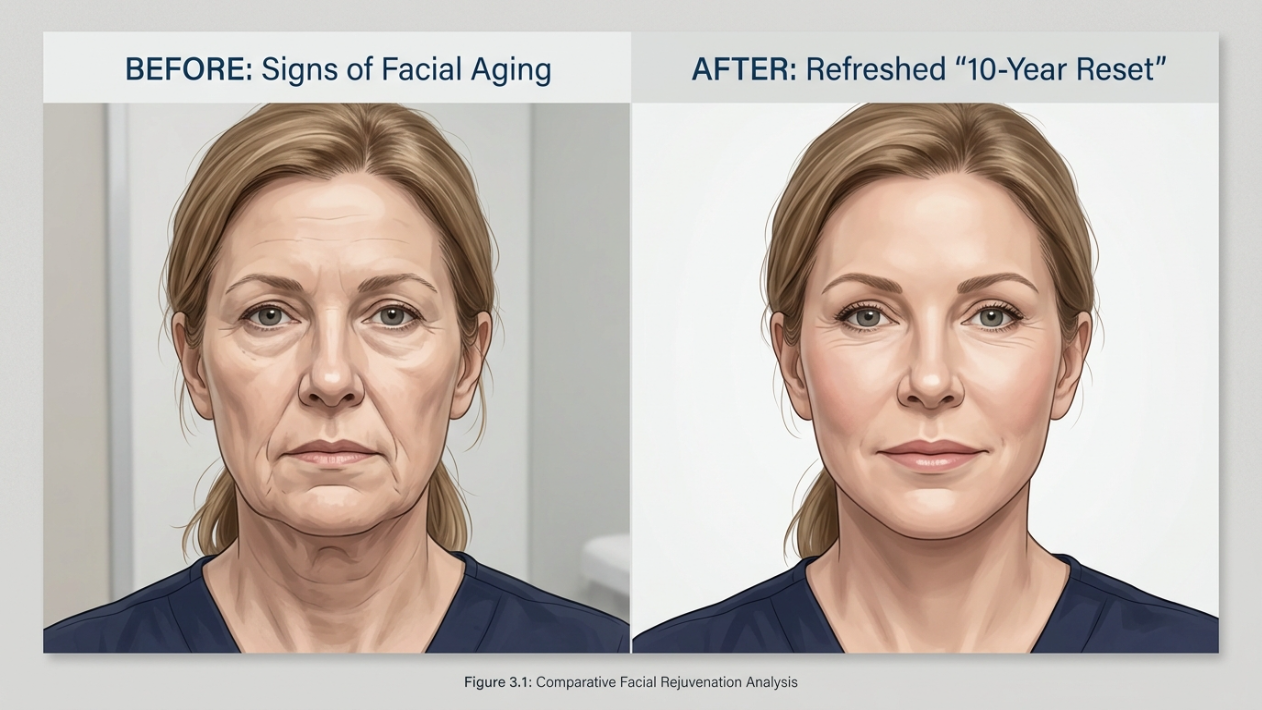
Clinical studies evaluating patient outcomes and independent observer ratings consistently show that a comprehensive facelift reduces perceived facial age by an average of 8 to 12 years. In cases involving significant midface descent or when combined with complementary procedures such as neck lifting or fat grafting, the visual reduction can approach 15 years.
However, perceived age reduction is not simply about removing excess skin. A face that looks artificially tight does not look younger; it simply looks operated on. True visual rejuvenation relies on restoring youthful geometry:
- Restoring Midface Volume: Elevating fallen malar fat pads back onto the cheekbones, reversing the hollowed midface appearance characteristic of aging.
- Softening Deep Folds: Easing prominent nasolabial folds (smile lines) and marionette lines from their structural source rather than pulling them laterally.
- Redefining the Jawline: Re-contouring jowls to recreate a crisp, uninterrupted mandibular line.
When deeper tissues are relocated to where they resided a decade prior, the outcome is not an altered facial expression, but a restoration of your own earlier appearance.
The Biological Reality: Resetting the Clock vs. Stopping the Clock
A critical concept for any patient evaluating facial surgery is the distinction between pausing aging and resetting it.
No surgical procedure can halt biological aging. Telomere shortening, gradual collagen degradation, loss of subcutaneous fat, and normal bone resorption in the facial skeleton continue every day after surgery.
Pre-Op Aging Baseline ───► [Surgery: 10-Year Reset] ───► Resumes Aging from Refreshed Baseline
                                                                 │
                                                       (Always 10 Years Ahead of
                                                        Unoperated Aging Curve)
Because your structural framework has been repositioned backward by 10 to 12 years, you will always look roughly 10 years younger than you would have without the surgery at any given point in the future. Ten years after your operation, you will not look like you did on the day of surgery, but you will still look significantly younger than if you had never undergone the procedure.
The 10–15 Year Longevity Mechanism of the Deep Plane Facelift
Traditional facelift techniques—such as skin-only lifts or standard SMAS (Superficial Musculoaponeurotic System) plication—typically offer visible improvement for 5 to 10 years. In contrast, a deep plane facelift routinely delivers results that endure for 10 to 15 years.
This difference in durability comes down to three structural factors beneath the skin.
1. Release of Facial Retaining Ligaments
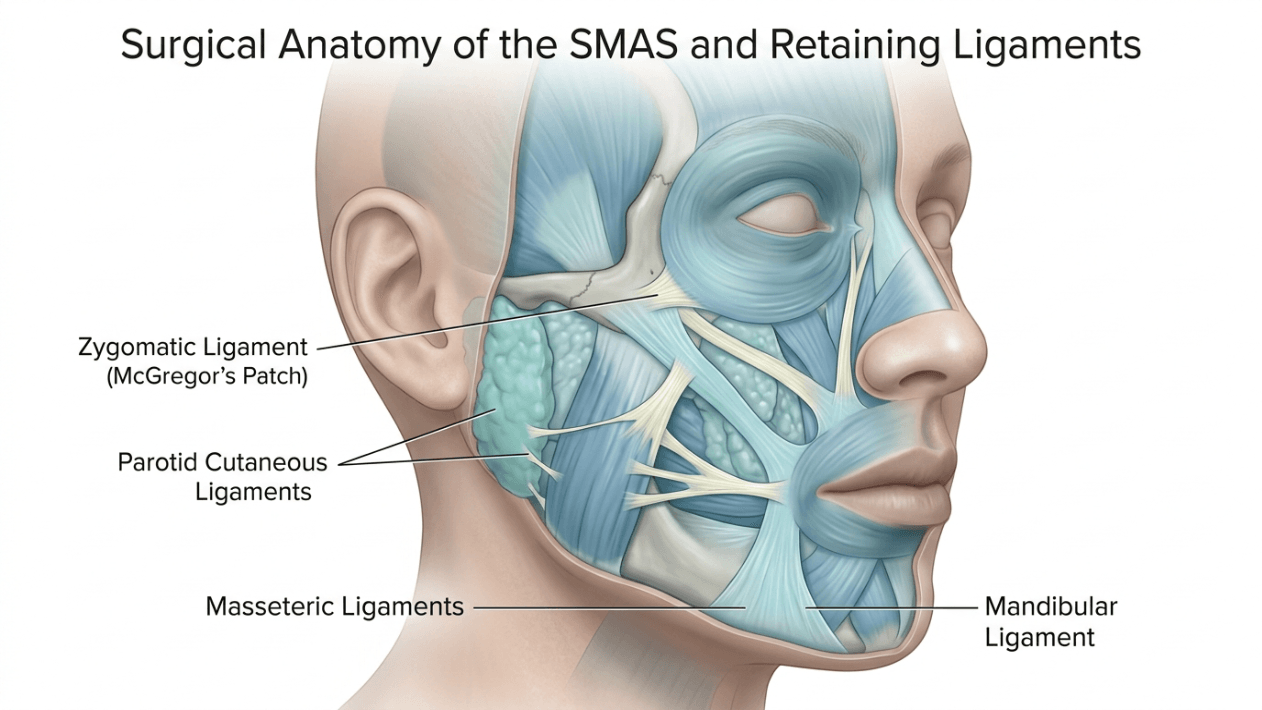
The human face contains dense fibrous anchors known as retaining ligaments—most notably the zygomatic, upper masseteric, and mandibular retaining ligaments. These ligaments act like anatomical pillars, binding the SMAS and deep facial tissues to the underlying facial skeleton.
In standard SMAS plication, these ligaments remain intact. As a result, attempting to lift descended tissue against fixed anchor points creates tension, limiting midface elevation and causing the result to relax much sooner.
In a deep plane facelift, the surgeon enters the sub-SMAS plane beneath the muscle layer and surgically releases these retaining ligaments. Once these anchors are freed, the deep tissues of the cheeks, jowls, and midface can be repositioned upward effortlessly without fighting structural resistance.
2. Composite Flap Elevation
Instead of separating the skin from the underlying muscle and pulling each layer independently, the deep plane technique elevates the skin, subcutaneous fat, and SMAS as a single, cohesive unit (a composite flap).
Because the natural vascular connections between the skin and underlying fat remain undisturbed:
- Skin quality and microcirculation are preserved.
- The risk of skin thinning or hollow contours is minimized.
- The entire structural architecture moves together into its original youthful position.
3. Tension-Free Skin Closure
When structural lifting relies on pulling the skin tightly, the skin rapidly stretches back out due to its inherent elasticity. This tension leads to early recurrence of sagging, widened surgical scars, and the unnatural “windswept” appearance associated with older facelift methods.
With the deep plane approach, 100% of the lifting vector is borne by the deep structural fascia and released ligaments. The skin is simply draped back over the newly restored foundation without tension, trimmed, and tailored. Because there is zero tension on the incision lines, surgical scars heal thin and inconspicuous, and the structural lift holds firm for a decade or more.
Deep Plane Facelift vs. SMAS Facelift: Structural Comparison
| Feature | SMAS Plication / Traditional Lift | Deep Plane Facelift |
| Surgical Dissection Plane | Above or on top of the SMAS layer | Sub-SMAS (beneath the SMAS layer) |
| Retaining Ligament Management | Left intact (anchors remain fixed) | Surgically released (zygomatic, masseteric, mandibular) |
| Vector of Elevation | Primarily lateral (pulled outward) | Vertical & diagonal (restoring natural youthful vector) |
| Primary Tension Point | Skin and superficial SMAS sutures | Deep structural fascia (zero tension on skin) |
| Midface & Jowl Correction | Moderate lower face improvement | Comprehensive midface, cheek, and jawline restoration |
| Average Longevity | 5 to 10 years | 10 to 15+ years |
Key Factors That Influence Your Results Over Time
While the surgical technique establishes the structural foundation for longevity, individual biological and environmental variables dictate how your results age over the subsequent decade:
- Skin Elasticity and Genetics: Thick, resilient skin with good intrinsic collagen density maintains structural contour longer than thin, severely sun-damaged tissue.
- Sun Protection: Ultraviolet radiation accelerates elastin degradation. Consistent broad-spectrum sun protection directly preserves the structural integrity of post-surgical results.
- Weight Stability: Significant fluctuations in weight after surgery stretch the facial envelope and alter subcutaneous fat volume, compromising jawline sharpness.
- Lifestyle Habits: Smoking and poor metabolic health impair microvascular circulation, reducing skin repair capacity and accelerating aging.
Frequently Asked Questions
Why do some facelifts look stretched while others look natural?
A stretched or “pulled” look occurs when a surgeon relies on skin tension to achieve a lift. A natural facelift outcome occurs when deeper muscle and fat structures are repositioned beneath the skin, allowing the skin to lay smoothly without pull or distortion.
Will I need a second facelift after 10 to 15 years?
Not necessarily. Many patients find that even after 15 years, their facial contours remain substantially better than their unoperated baseline. If a patient chooses to undergo a secondary touch-up later in life, the procedure is typically less extensive than the primary operation.
How does neck lifting fit into deep plane facelift longevity?
The neck and jawline function as a continuous anatomical unit. Releasing the platysma muscle and deep neck fat structures during a deep plane procedure ensures that the neck aging rate matches the refreshed midface, preventing premature recurrence of platysmal banding or submental sagging.
Sources
- Dr. Berat Çiğdem Plastic Surgery Clinic Official Website & Clinical Practice. https://drberatplasticsurgery.com/
- Plastic and Reconstructive Surgery Journal. “Quantitative Evaluation of Perceived Age Reduction Following Facial Rejuvenation Surgery.”
- Jacono, A. A., et al. “A Longitudinal Study of Deep-Plane Facelift Longevity and Patient Satisfaction over 10 Years.” Aesthetic Surgery Journal.
- Stuzin, J. M. “Maintaning Structural Integrity in Facial Rejuvenation: The Role of Retaining Ligaments in Sub-SMAS Dissection.” Plastic and Reconstructive Surgery.