

In 2026, the science of facial aging has evolved beyond superficial skin tightening to address the foundational changes that occur beneath the surface. Aging is not merely a matter of wrinkles or sagging skin—it is a complex, multifactorial process involving the displacement of fat pads, bone resorption, and deep tissue remodeling. Understanding these mechanisms is essential for achieving natural, long-lasting results in facial rejuvenation, particularly through advanced procedures like the facelift. This guide explores the anatomical science behind facial aging and how modern facelift techniques, including regenerative medicine, restore youthful contours from the inside out.

Table of Contents
The Hidden Anatomy of Facial Aging: Fat Pad Displacement and Bone Resorption
Facial aging is driven by two critical, often overlooked processes: the descent of facial fat pads and the resorption of underlying bone. These changes are not uniform but occur in specific, predictable patterns that directly influence the visible signs of aging.
Fat Pad Descent: The Loss of Youthful Volume and Contour
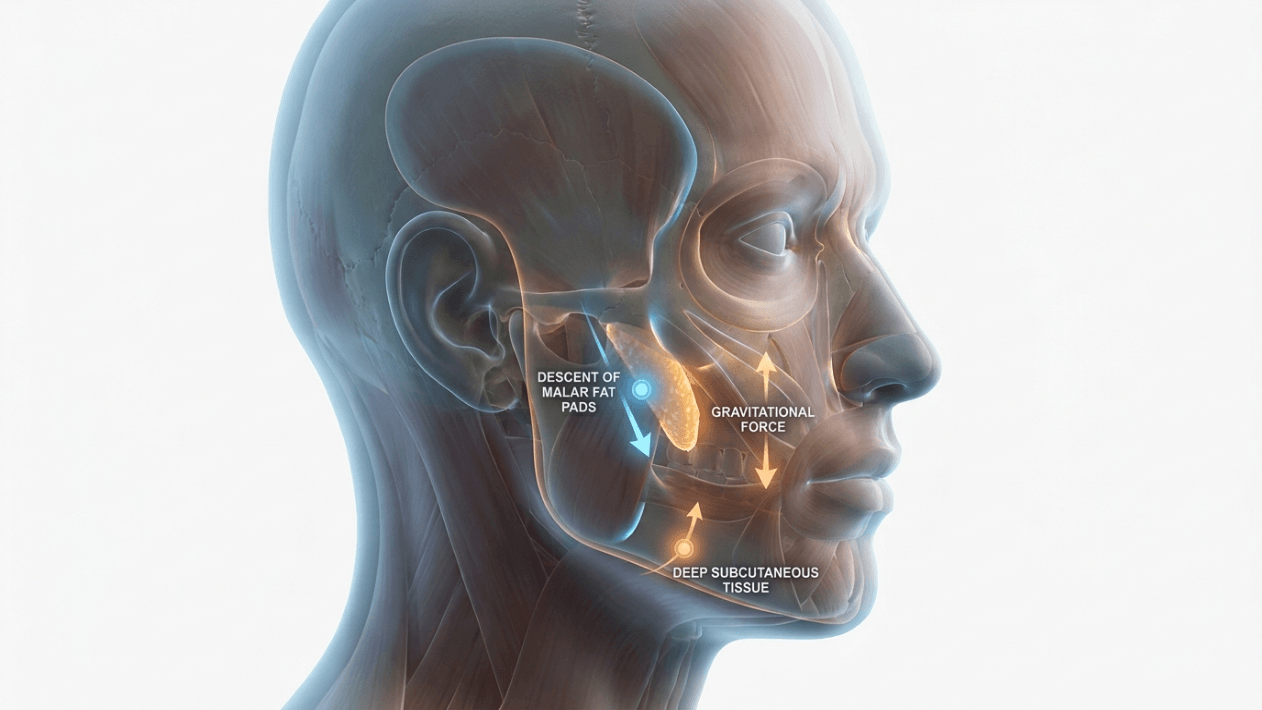
The face is structured by a network of discrete fat compartments, each serving as a cushion that maintains youthful fullness and contour. As we age, these fat pads undergo two key changes: they lose volume (atrophy) and shift downward due to gravity and the weakening of supporting ligaments. This descent is most pronounced in the midface, where the malar fat pad slides inferiorly, leading to the formation of nasolabial folds, jowls, and a loss of cheek definition. The buccal fat pad, once providing fullness to the cheeks, can herniate or sag, further contributing to an aged appearance (PMC7394156).
This downward migration is not merely a gravitational effect but is also influenced by changes in the elasticity and integrity of the Superficial Musculoaponeurotic System (SMAS), the fibrous network that connects facial muscles to the skin. As the SMAS weakens, it loses its ability to support the overlying fat and skin, exacerbating sagging and volume loss.
Bone Resorption: The Shrinking Foundation of the Face
While fat pad displacement is a major contributor to facial aging, the underlying bone structure also undergoes significant changes. Bone resorption—the gradual loss of bone density and volume—occurs throughout the facial skeleton, but it is most pronounced in the orbital rims, maxilla, and mandible. Studies using 3D imaging have shown that the orbital aperture enlarges with age, the maxilla recedes, and the mandible loses height and projection. These skeletal changes reduce the structural support for soft tissues, leading to a deflated, hollowed appearance, particularly in the midface and temples (PMC3404279).
Bone resorption is not uniform; it occurs in specific regions that directly correlate with the areas where aging is most visible. For example, the superomedial and inferolateral aspects of the orbital rim resorb, contributing to the appearance of sunken eyes and a tired look. Similarly, resorption of the mandibular body and angle leads to a loss of jawline definition and the formation of jowls. These bony changes are a primary reason why traditional skin-only facelifts often fail to deliver natural or long-lasting results—they do not address the foundational loss of support.
The Interplay Between Fat and Bone: A Dynamic Process
The relationship between fat pad displacement and bone resorption is dynamic and synergistic. As bone resorbs, the overlying fat pads lose their structural anchorage, accelerating their descent. Conversely, the loss of fat volume can make bony changes more apparent, creating a feedback loop that amplifies the signs of aging. This interplay explains why addressing only one aspect of facial aging—such as tightening the skin—often yields incomplete or unnatural results. True rejuvenation requires a holistic approach that targets both soft tissue repositioning and the restoration of underlying skeletal support.
Facelift Techniques in 2026: Restoring Structure, Not Just Skin
The evolution of facelift techniques reflects a growing understanding of the deep anatomical changes that drive facial aging. Modern facelifts are designed to address both fat pad displacement and bone resorption, using advanced surgical approaches to restore youthful contours. The two most effective techniques in 2026 are the SMAS facelift and the deep plane facelift, each offering unique advantages in targeting the underlying causes of aging.
SMAS Facelift: Precision and Customization
The SMAS facelift is the gold standard for facial rejuvenation, offering a high degree of customization and precision. This technique involves lifting and repositioning the SMAS layer, which provides structural support to the face. By addressing the SMAS, surgeons can achieve a more natural and durable lift, as this layer is responsible for maintaining the position of the overlying fat pads and skin.
In a traditional SMAS facelift, the surgeon makes incisions along the hairline and around the ears, then carefully dissects and lifts the SMAS layer. The SMAS is then sutured in a new, elevated position, effectively repositioning the descended fat pads and restoring youthful contours. The high-SMAS technique, a more advanced variation, involves a higher entry point for the SMAS lift, which allows for greater mobilization of the midface tissues and a more comprehensive rejuvenation of the cheek and lower eyelid areas (PMID30513537).
The SMAS facelift is particularly effective for patients with moderate to severe sagging, as it provides a robust lift that can be tailored to the individual’s unique anatomy. Recovery is typically shorter than with more invasive techniques, and the results are natural-looking, with minimal risk of a “pulled” or artificial appearance.

Deep Plane Facelift: Comprehensive Rejuvenation for Advanced Aging
For patients with more advanced signs of aging, the deep plane facelift offers a comprehensive solution. This technique involves lifting the SMAS and the deeper facial muscles as a single unit, providing a more powerful and long-lasting lift. The deep plane approach is particularly effective for addressing significant sagging in the midface and jowls, as it allows for the release of key retaining ligaments that contribute to facial descent.
The deep plane facelift begins with the same incisions as the SMAS facelift, but the dissection extends deeper, beneath the SMAS layer, to mobilize the entire soft tissue envelope of the face. This technique allows for the repositioning of the descended fat pads and the restoration of volume to the midface, resulting in a more natural and harmonious rejuvenation. The deep plane facelift is often combined with a neck lift to address the entire lower face and neck, ensuring a cohesive and balanced outcome (PMID39820938).
One of the key advantages of the deep plane facelift is its ability to address the midface more effectively than the SMAS technique. By releasing the zygomatic and masseteric retaining ligaments, the deep plane facelift allows for greater mobilization of the midface tissues, resulting in a more natural and youthful contour. However, this technique is more invasive and requires a longer recovery period, making it best suited for patients with significant signs of aging.
Regenerative Medicine: The Future of Facial Rejuvenation
While surgical facelifts remain the most effective solution for advanced facial aging, regenerative medicine is emerging as a complementary approach to enhance and prolong results. Regenerative techniques, such as platelet-rich plasma (PRP), stem cell therapy, and exosome treatments, harness the body’s natural healing mechanisms to promote tissue regeneration, improve skin quality, and support long-term rejuvenation.
PRP, derived from the patient’s own blood, is rich in growth factors that stimulate collagen production and tissue repair. When injected into the face, PRP can improve skin texture, reduce fine lines, and enhance the overall quality of the skin. Stem cell therapy, particularly using adipose-derived stem cells (ASCs), has shown promise in restoring volume and promoting tissue regeneration. These cells can be harvested from the patient’s own fat and injected into areas of volume loss, such as the cheeks or temples, to restore youthful fullness (EuropePMC34102897).
Exosome therapy is another cutting-edge regenerative technique gaining traction in 2026. Exosomes are tiny vesicles released by stem cells that contain growth factors and genetic material capable of promoting cellular repair and regeneration. When applied to the skin or injected into deeper tissues, exosomes can enhance collagen production, improve skin elasticity, and accelerate healing. While regenerative medicine cannot replace the structural changes achieved through surgery, it is a powerful tool for optimizing and maintaining results, particularly in patients seeking a more natural and holistic approach to rejuvenation.

Why Understanding Facial Anatomy Matters in Facelift Surgery
The science of facial aging underscores why a deep understanding of anatomy is critical for successful facelift surgery. The face is not a single, uniform structure but a complex interplay of bone, fat, muscle, and skin, each of which ages differently. A facelift that focuses solely on tightening the skin will fail to address the underlying causes of aging, resulting in temporary or unnatural outcomes. In contrast, techniques that target the SMAS, deep fat pads, and even the underlying bone provide more durable and natural-looking results.
The Role of the Surgeon: Artistry Meets Science
The success of a facelift depends not only on the technique used but also on the skill and experience of the surgeon. A board-certified plastic surgeon with expertise in facial anatomy can tailor the procedure to the patient’s unique needs, ensuring that the lift addresses both fat pad displacement and bone resorption. This personalized approach is essential for achieving results that look natural and harmonious, rather than overdone or artificial.
During the consultation, the surgeon will assess the patient’s facial structure, skin quality, and aesthetic goals. Advanced imaging techniques, such as 3D scans, may be used to visualize the underlying bone and fat pad anatomy, allowing for a more precise surgical plan. This level of detail ensures that the facelift not only lifts the skin but also restores the foundational support that has been lost over time.

The Antalya Approach: Holistic Facial Rejuvenation
In Antalya, a hub for advanced aesthetic surgery, surgeons are pioneering a holistic approach to facial rejuvenation that integrates the latest scientific insights with artistic precision. This approach recognizes that facial aging is a three-dimensional process, requiring a three-dimensional solution. By combining advanced facelift techniques with regenerative medicine, Antalya’s surgeons are able to address both the structural and aesthetic aspects of aging, delivering results that are not only natural but also long-lasting.
The Antalya approach also emphasizes the importance of cultural sensitivity and individualized care. Surgeons in the region understand that aesthetic ideals vary across cultures and that a one-size-fits-all approach is insufficient. By tailoring each procedure to the patient’s unique anatomy and goals, Antalya’s surgeons ensure that the results enhance the patient’s natural beauty, rather than conforming to a generic standard.

The Future of Facelifts: Science-Driven, Patient-Centered
As the science of facial aging continues to advance, so too do the techniques used in facelift surgery. The future of facelifts lies in a deeper understanding of the anatomical changes that drive aging, combined with innovative approaches to restore youthful contours. Regenerative medicine, in particular, is poised to play a transformative role, offering new ways to enhance and prolong the results of surgery.
For patients considering a facelift, the key to achieving natural, long-lasting results is to choose a surgeon who understands the science of facial aging and is skilled in the latest techniques. Whether opting for a SMAS facelift, a deep plane facelift, or a combination of surgery and regenerative medicine, the goal is the same: to restore the face’s youthful structure and harmony, ensuring that the results look as natural as they feel.
Frequently Asked Questions About Facial Aging and Facelift Surgery
What are the primary causes of facial aging beyond wrinkles?
Facial aging is driven by two key anatomical processes: the descent of facial fat pads and the resorption of underlying bone. Fat pads lose volume and shift downward due to gravity and weakening of the SMAS, while bone resorption reduces structural support, leading to a deflated, hollowed appearance. These changes are responsible for the formation of jowls, nasolabial folds, and a loss of jawline definition.
How do SMAS and deep plane facelifts differ in addressing facial aging?
The SMAS facelift targets the Superficial Musculoaponeurotic System, lifting and repositioning this layer to restore youthful contours. It is highly customizable and ideal for moderate sagging. The deep plane facelift, in contrast, lifts the SMAS and deeper facial muscles as a single unit, providing a more comprehensive rejuvenation for advanced aging by releasing key retaining ligaments and restoring midface volume.
Can regenerative medicine enhance the results of a facelift?
Yes, regenerative medicine techniques such as PRP, stem cell therapy, and exosome treatments can complement facelift surgery by promoting tissue regeneration, improving skin quality, and enhancing collagen production. While these treatments cannot replace the structural changes achieved through surgery, they are valuable for optimizing and maintaining results, particularly in patients seeking a natural and holistic approach.
Why is bone resorption a critical factor in facial aging?
Bone resorption leads to a loss of structural support for the overlying soft tissues, resulting in a deflated, aged appearance. As the orbital rims, maxilla, and mandible resorb, the face loses its youthful projection and definition. Addressing bone resorption is essential for achieving natural, long-lasting results in facial rejuvenation.
What makes the Antalya approach to facelifts unique?
The Antalya approach combines advanced facelift techniques with regenerative medicine, addressing both the structural and aesthetic aspects of aging. Surgeons in Antalya emphasize cultural sensitivity and individualized care, tailoring each procedure to the patient’s unique anatomy and goals to ensure natural, harmonious results.
How long do the results of a modern facelift last?
The results of a modern facelift, particularly when combined with regenerative medicine, can last 7-10 years or more. The longevity of the results depends on factors such as the technique used, the patient’s skin quality, and their lifestyle. Maintaining a healthy lifestyle and following post-operative care instructions can help extend the duration of the results.